
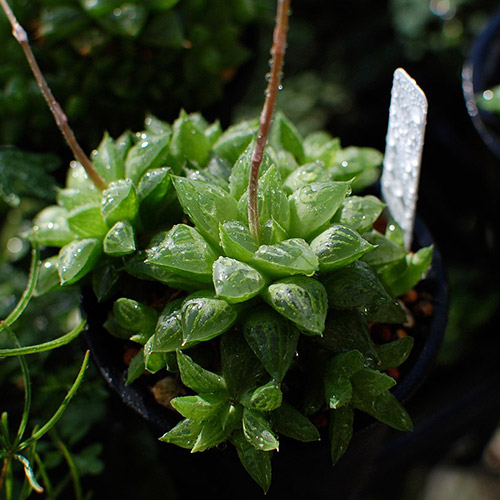
Quick Facts
Key growing and identification information for Haworthia turgida.
Identification
Look for these characteristics when identifying Haworthia turgida.
How to Grow Haworthia turgida
Use these growing guidelines as a practical starting point and adjust for local conditions.
Light
Haworthia turgida grows in full sun to partial shade. Indoors, place it near a bright window. In the Northern Hemisphere, a south-facing window can provide strong light.
Introduce intense direct sunlight gradually to reduce the risk of sun damage.
Water
Use the soak-and-dry method. Water the soil thoroughly, then allow it to dry completely before watering again.
Avoid leaving the roots in consistently wet soil.
Soil
Use fast-draining succulent soil in a container with an open drainage hole. The growing medium should release excess water instead of remaining wet around the roots.
Temperature
This plant is not cold hardy. Protect it when temperatures approach 30°F (-1.1°C).
In colder climates, grow it in a container that can be moved indoors.
Containers
Its compact size and slow growth make it suitable for small containers and indoor succulent collections.
Outdoor Growing
In suitable climates, offsets can gradually form clumps that spread into a low mat.
Propagation by Offsets
Haworthia turgida produces small offsets around the base of the parent plant.
- Locate a healthy offset growing beside the parent plant.
- Carefully separate the offset without unnecessarily damaging its base.
- Allow the separated offset to dry for one to two days.
- Plant it in a small container filled with well-draining succulent soil.
- Allow the soil to dry between waterings while the offset establishes roots.
Scientific Classification
The botanical classification currently used for this plant profile.
| Kingdom | Plantae |
|---|---|
| Clade | Tracheophytes |
| Clade | Angiosperms |
| Clade | Monocots |
| Order | Asparagales |
| Family | Asphodelaceae |
| Subfamily | Asphodeloideae |
| Genus | Haworthia |
| Species | Haworthia turgida |
Toxicity: Haworthia turgida is generally considered non-toxic. However, prevent children and animals from chewing unfamiliar plants, and contact an appropriate medical or veterinary professional if ingestion causes symptoms.
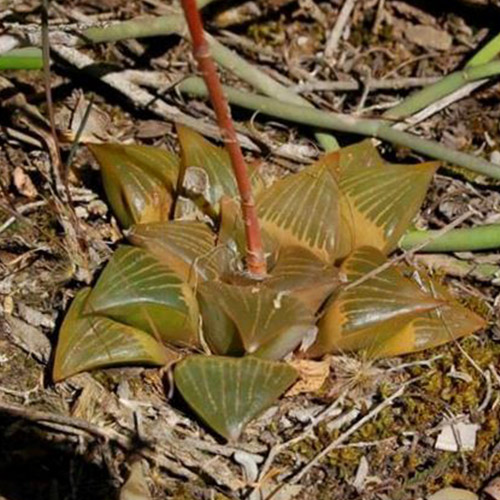
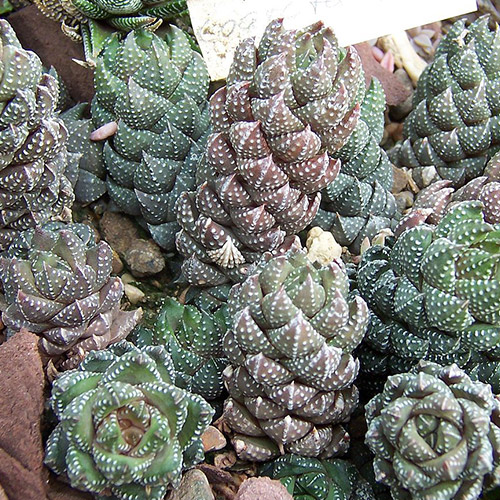
Sources and Image Attribution
Plant details are compiled from the existing Xerophyte.Garden profile and its cited botanical classification.
Primary image by salchuiwt via Wikimedia Commons.

