
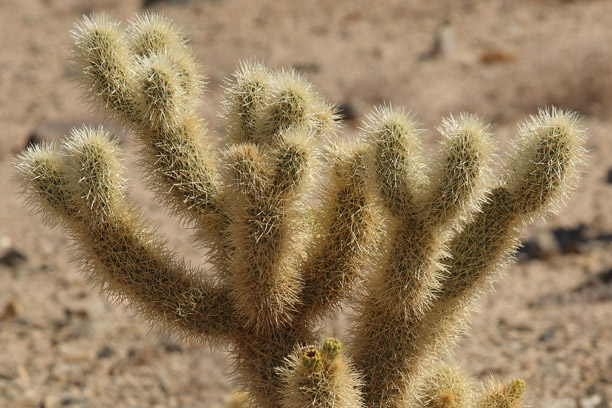
What is a Cholla?
A cholla is a cactus belonging to the genus Cylindropuntia. Chollas are recognized by their cylindrical, jointed stems and formidable spines. They grow primarily in deserts and dry regions of the southwestern United States and Mexico.
Some chollas are called jumping chollas because their stem segments detach easily when touched. Despite the nickname, the cactus cannot actually jump.
What Does a Cholla Cactus Look Like?
Chollas range from low-growing plants to large, branching cacti that resemble shrubs or small trees. Their most recognizable features include:
- Cylindrical, segmented stems
- Clusters of sharp spines
- A papery sheath covering many of the spines
- Flowers that may be yellow, green, orange, red, pink, or purple
- Dry or fleshy fruit, depending on the species
The cylindrical stems distinguish chollas from many prickly pear cacti, which generally have broad, flattened pads. Both groups belong to the cactus family and are closely related.
Like other cacti, chollas are succulent plants. Their thickened stems store water and perform photosynthesis, while their spines help protect the plant and reduce exposure to harsh desert conditions.
Why Is It Called a Jumping Cholla?
A jumping cholla does not move or launch its stems through the air. Its terminal joints are simply attached loosely enough to detach when a person or animal brushes against them.
The spines have tiny barbs that can catch on skin, fur, shoes, and clothing. When the affected person or animal pulls away, an entire stem segment may separate from the parent plant.
This is an effective method of vegetative reproduction. After the detached joint eventually falls to the ground, it may develop roots and grow into another plant when conditions are suitable.
The National Park Service notes that teddybear cholla frequently reproduce through fallen stem joints because their seeds are often infertile.
Are All Chollas Jumping Chollas?
No. Cholla is a general name applied to numerous species in the genus Cylindropuntia. The stems of some species detach much more readily than others.
The name jumping cholla is most closely associated with species such as Cylindropuntia fulgida. Teddybear cholla, Cylindropuntia bigelovii, is also frequently described as a jumping cholla because its densely spined joints detach easily.
Common Types of Cholla
Teddybear Cholla
Cylindropuntia bigelovii has dense, pale spines that can make the plant appear soft or fuzzy from a distance. The inviting appearance is deceptive. Its joints detach easily, and its barbed spines can be painful to remove.
Jumping Cholla
Cylindropuntia fulgida is known for stem segments that readily attach to animals and people. It is also called chain-fruit cholla because older fruits may remain connected and form hanging chains.
Buckhorn Cholla
Cylindropuntia acanthocarpa is a branching cactus with elongated joints. Depending on the plant and location, its flowers may appear yellow, orange, red, or combinations of those colors.
Walkingstick Cholla
Cylindropuntia spinosior develops a branching, tree-like shape. Its joints tend to remain more firmly attached than those of the plants commonly called jumping chollas.
Where Do Cholla Cacti Grow?
Chollas are native to the Americas, with many species growing in the deserts and drylands of Mexico and the southwestern United States. They are particularly associated with Arizona, California, Nevada, New Mexico, and Texas.
Different species tolerate different elevations, temperatures, and soil conditions. Some inhabit intensely hot desert basins, while others grow in colder or higher locations.
One of the most recognizable concentrations is the Cholla Cactus Garden in Joshua Tree National Park. Thousands of teddybear chollas grow there in the transition zone between the Colorado and Mojave deserts.
How Do Chollas Survive in the Desert?
Chollas have several adaptations that help them survive dry environments:
- Water-storing stems: Their fleshy stems retain moisture after rainfall.
- Spines instead of conventional leaves: Spines protect the plant and help limit moisture loss.
- Shallow roots: Roots near the soil surface can absorb water from brief desert rain.
- Vegetative reproduction: Detached joints can root and establish new plants.
- Stem photosynthesis: Green stems produce energy without broad leaves.
Can You Grow a Cholla at Home?
Chollas can be grown in an appropriate dry garden, but they are not ideal for every home or landscape. Their barbed spines and detachable joints make placement particularly important.
A cholla should be kept away from sidewalks, play areas, pets, entrances, and other frequently used spaces. Gardeners should also check whether the selected species is appropriate for the local climate and permitted in their area.
When planting a cholla, provide abundant sunlight, fast-draining soil, and enough space for its mature form. Avoid soil that remains wet for extended periods. Our guide to planting succulents explains the importance of drainage and healthy root conditions.
Use long-handled tools and thick protective equipment when working near a cholla. Ordinary gardening gloves may not stop its spines.
What Should You Do If a Cholla Attaches to You?
Do not grab an attached segment with an unprotected hand. Doing so can create a second injury.
Move away from the parent plant first. A comb, multitool, or similar object may help lift the segment away without directly touching it. Individual spines can then be removed carefully with tweezers.
Seek professional medical care for spines near the eyes or face, deep injuries, severe pain, signs of infection, or spines that cannot be removed safely.
Is Cholla a Cactus or a Succulent?
A cholla is both a cactus and a succulent. It is a cactus because it belongs to the cactus family, Cactaceae. It is also a succulent because its stems store water.
Not every succulent is a cactus, but every cactus is considered a succulent. See our succulent glossary for more definitions and plant terminology.
Understanding Cholla Cacti
Chollas are jointed desert cacti in the genus Cylindropuntia. Their cylindrical stems, dense spines, and ability to reproduce from detached joints make them particularly well adapted to dry environments.
The so-called jumping cholla does not literally jump. Its loosely connected joints and barbed spines allow it to attach to passing animals and people, travel away from the parent plant, and potentially take root in a new location.

